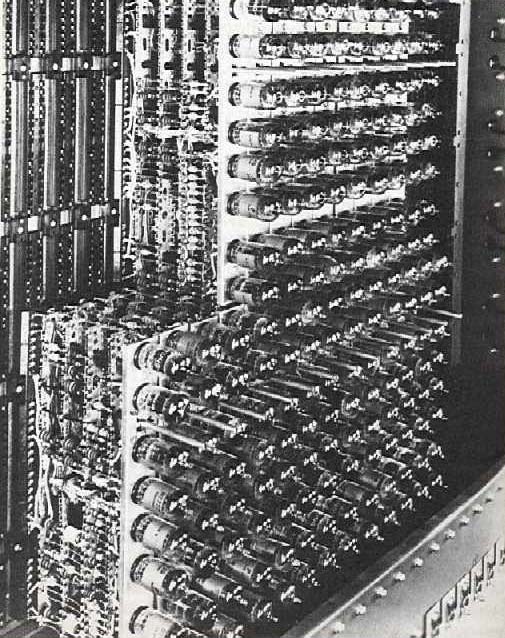
 First Generation - 1940-1956: Vacuum Tubes
The first computers used vacuum tubes for circuitry and magnetic drums for memory, and were often enormous, taking up entire rooms. A magnetic drum,also referred to as drum, is a metal cylinder coated with magnetic iron-oxide material on which data and programs can be stored. Magnetic drums were once use das a primary storage device but have since been implemented as auxiliary storage devices.
The tracks on a magnetic drum are assigned to channels located around the circumference of the drum, forming adjacent circular bands that wind around the drum. A single drum can have up to 200 tracks. As the drum rotates at a speed of up to 3,000 rpm, the device's read/write heads deposit magnetized spots on the drum during the write operation and sense these spots during a read operation. This action is similar to that of a magnetic tape or disk drive.
Second Generation - 1956-1963: Transistors
Transistors replaced vacuum tubes and ushered in the second generation computer. Transistor is a device composed of semiconductor material that amplifies a signal or opens or closes a circuit. Invented in 1947 at Bell Labs, transistors have become the key ingredient of all digital circuits, including computers. Today'slatest microprocessor contains tens of millions of microscopic transistors.Prior to the invention of transistors, digital circuits were composed of vacuum tubes, which had many disadvantages. They were much larger, required more energy, dissipated more heat, and were more prone to failures. It's safe to say that without the invention of transistors, computing as we know it today would impossible.
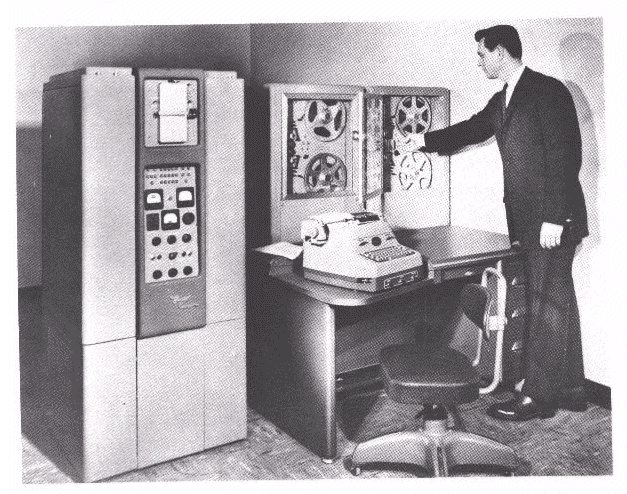 The transistor was invented in 1947 but did not see widespread use in computers until the late 50s. The transistor was far superior to the vacuum tube,allowing computers to become smaller, faster, cheaper,more energy-efficient and more reliable than their first-generation predecessors. Though the transistor still generated a great deal of heat that subjected the computer to damage,
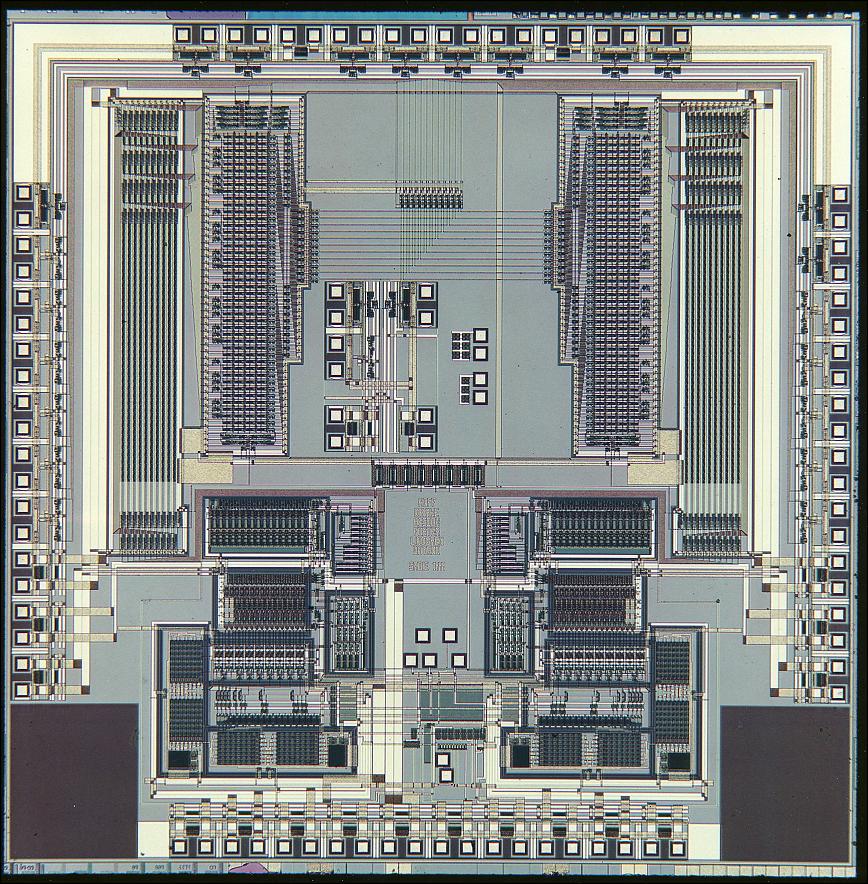 Third Generation - 1964-1971: Integrated Circuits
The development of the integrated circuit was the hallmark of the third generation of computers. Transistors were miniaturized and placed on silicon chips, called semiconductors, which drastically increased the speed and efficiency of computers.
A nonmetallic chemical element in the carbon family of elements. Silicon - atomic symbol "Si" - is the second most abundant element in the earth's crust, surpassed only by oxygen. Silicon does not occur uncombined in nature. Sand and almost all rocks contain silicon combined with oxygen, forming silica. When silicon combines with other elements, such as iron, aluminum or potassium, a silicate is formed. Compounds of silicon also occur in the atmosphere, natural waters,many plants and in the bodies of some animals.Silicon is the basic material used to make computer chips, transistors, silicon diodes and other electronic circuits and switching devices because its atomic structure makes the element an ideal semiconductor. Silicon is commonly doped, or mixed,with other elements, such as boron, phosphorous and arsenic, to alter its conductive properties.
Three basic characteristics differentiate microprocessors:
What in the first generation filled an entire room could now fit in the palm of the hand. The Intel 4004chip, developed in 1971, located all the components of the computer - from the central processing unit and memory to input/output controls - on a single chip.
A nonmetallic chemical element in the carbon family of elements. Silicon - atomic symbol "Si" - is the second most abundant element in the earth's crust, surpassed only by oxygen. Silicon does not occur uncombined in nature. Sand and almost all rocks contain silicon combined with oxygen, forming silica. When silicon combines with other elements, such as iron, aluminum or potassium, a silicate is formed. Compounds of silicon also occur in the atmosphere, natural waters,many plants and in the bodies of some animals.Silicon is the basic material used to make computer chips, transistors, silicon diodes and other electronic circuits and switching devices because its atomic structure makes the element an ideal semiconductor. Silicon is commonly doped, or mixed,with other elements, such as boron, phosphorous and arsenic, to alter its conductive properties.
Fourth Generation - 1971-Present: Microprocessors
The microprocessor brought the fourth generation of computers, as thousands of integrated circuits we rebuilt onto a single silicon chip. A silicon chip that contains a CPU. In the world of personal computers,the terms microprocessor and CPU are used interchangeably. At the heart of all personal computers and most workstations sits a microprocessor. Microprocessors also control the logic of almost all digital devices, from clock radios to fuel-injection systems for automobiles.Three basic characteristics differentiate microprocessors:
- Instruction Set: The set of instructions that the microprocessor can execute.

- Bandwidth: The number of bits processed in a single instruction.
- Clock Speed: Given in megahertz (MHz), the clock speed determines how many instructions per second the processor can execute.
What in the first generation filled an entire room could now fit in the palm of the hand. The Intel 4004chip, developed in 1971, located all the components of the computer - from the central processing unit and memory to input/output controls - on a single chip.
 Fifth Generation - Present and Beyond: Artificial Intelligence
Fifth generation computing devices, based on artificial intelligence, are still in development,though there are some applications, such as voice recognition, that are being used today.Artificial Intelligence is the branch of computer science concerned with making computers behave like humans. The term was coined in 1956 by John McCarthy at the Massachusetts Institute of Technology. Artificial intelligence includes:
- Games Playing: programming computers to play games such as chess and checkers
- Expert Systems: programming computers to make decisions in real-life situations (for example, some expert systems help doctors diagnose diseases based on symptoms)
- Natural Language: programming computers to understand natural human languages
- Neural Networks: Systems that simulate intelligence by attempting to reproduce the types of physical connections that occur in animal brains
- Robotics: programming computers to see and hear and react to other sensory stimuli
In the area of robotics, computers are now widely used in assembly plants, but they are capable only of very limited tasks. Robots have great difficulty identifying objects based on appearance or feel, and they still move and handle objects clumsily.

No comments:
Post a Comment